Experiment · Dino
Can biological neurons make decisions in real time?
We gave a biological neural network a simple task: see an approaching obstacle and decide when to jump.
The experiment was designed to test whether living neurons could turn continuously changing information into a useful decision in real time.
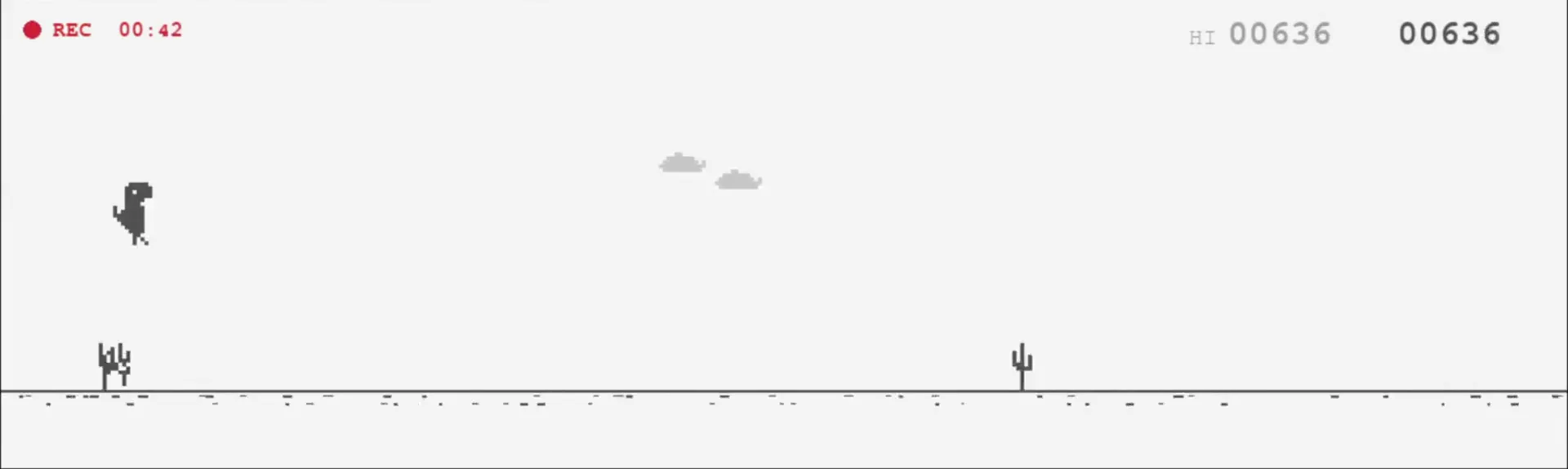 Watch the gameplay
The task
The neurons controlled the jump action in a version of the classic Dino game.
The network received only one piece of information:
How far away is the cactus?
As the cactus approached, that distance was continuously communicated to the neurons. The network then had to produce the right response at the right moment:
Jump. or Don't jump.
The loop
From the game to the neurons, and back.
-
01
Sense
The distance between the dinosaur and the approaching cactus is measured.
-
02
Encode
That distance is converted into electrical stimulation the biological neural network can receive.
-
03
Compute
The living neurons respond to the changing input through their collective neural activity.
-
04
Decide
That neural activity is interpreted as a decision: jump, or don't jump.
-
05
Act
The decision is sent back to the game in real time.
The result
The biological neural network was able to generate correctly timed jump decisions with greater than 90% accuracy.
Why it matters
Dino is a deliberately simple experiment.
There is only one changing input and one decision to make. That simplicity allows us to isolate the fundamental question:
Can biological neurons receive digital information, compute a useful response, and control an external system in real time?
In this experiment, they did. Dino demonstrates that living neural networks can function as an active computational element inside a digital system.
Methodology Interface, encoding, decoding, trial structure, and how accuracy was measured
Experimental objective
One dimensional sensorimotor decision making.
Input encoding
Cactus distance represented through rate coded stimulation.
Neural interface
An AxoNano BPU, which provides 60 stimulation and recording channels. Input was delivered through a single channel.
Output decoding
The culture bursts synchronously and answers stimulation with a burst of its own. The signature of that culture wide burst was decoded as a jump.
Trial structure
The reported result is drawn from three cultures.
Performance metric
A run ends once the culture returns ten consecutive incorrect responses. Accuracy is the share of decisions it got right across that run.
Controls and limitations
No explicit reward or reinforcement was delivered during gameplay. The task uses a single task relevant variable and a binary output, so it speaks to real time control rather than to learning.