Experiment · Asteroid Dodger
Can biological neurons learn through feedback?
We gave a biological neural network a more difficult task: control a spacecraft, avoid incoming asteroids, and get better through experience.
Unlike Dino, the correct action wasn't a single jump at the right moment. The neurons had to continuously interpret a changing environment, control movement in real time, and learn from the consequences of their actions.
The task
The network controlled the horizontal movement of a spacecraft while asteroids continuously approached from above.
The neurons received information about where the asteroid was and how close it was getting. From that, the network continuously controlled whether the spacecraft moved left or right.
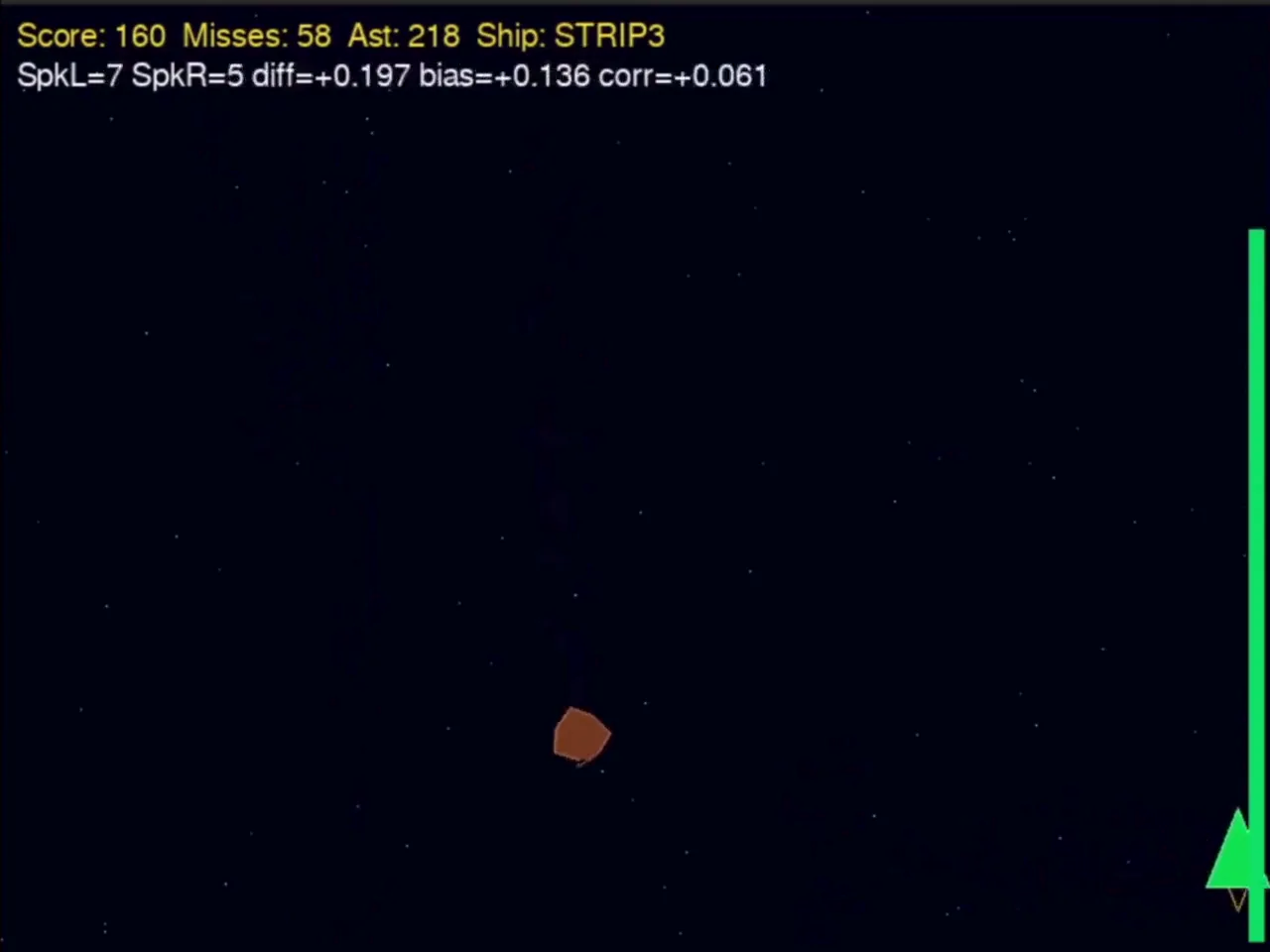 Watch the gameplay
Feedback
This time, we added feedback.
Every action had a consequence.
Successful dodge
The network received positive feedback.
Collision
The network received negative feedback and the task restarted.
Through repeated interaction with the environment, the biological network began changing its behaviour.
See. Act. Receive feedback. Adapt. Repeat.
The result
The neurons learned.
-
~6 min
Learning begins
Performance began improving after approximately six minutes of interaction.
-
~12 min
Peak performance
The network reached its highest task performance after approximately twelve minutes.
-
86.5%
Peak dodge rate
At peak performance, the biological network successfully avoided 86.5% of incoming asteroids.
The control
Feedback made the difference.
To test whether the improvement was actually associated with feedback, we ran the same task with a control network. It received the same sensory information, but no feedback about whether its actions were successful. The control did not develop the same task proficiency.
With feedback
The neurons progressively improved their ability to control the spacecraft.
Without feedback
Performance did not show the same improvement over time.
Why it matters
Asteroid Dodger demonstrates something fundamentally different from a fixed biological response.
The neurons were placed inside a closed loop where their actions affected the environment, the environment produced feedback, and that feedback shaped future behaviour. Over time, the biological network became better at the task.
The biological substrate learned.
Resource profile
How efficient was the learning?
We also compared the biological network with a conventional AI system trained on the same task. The two systems operate fundamentally differently, so this is not a like for like comparison. Instead, it provides an early look at their different resource profiles.
Time to peak performance
Measured system energy
About 72× less energy, on these measurements.
An early benchmark between fundamentally different systems rather than a claim that one beats the other. The AI baseline received a more explicit state representation, including information not given directly to the biological system.
Methodology Stimulation encoding, motor decoding, feedback protocol, performance, and controls
Experimental objective
Continuous sensorimotor control with closed loop feedback, testing whether task performance improves through interaction.
Stimulation encoding
The arena is divided into four vertical strips, each with a corresponding electrode, giving four input channels. Which strip the asteroid occupies carries its position, and the distance between the asteroid and the ship is rate coded.
Motor decoding
Two decoding areas are read, one for left and one for right. The difference in their spike counts within a 20 ms bin becomes movement in the game.
Feedback protocol
Reward is a consistent pattern delivered across all input channels. Punishment is random noise, followed by a period of rest and a reset of the task.
Performance metric
Measured per rally: how many asteroids the network dodged in a single rally, and how long that rally lasted.
Controls and limitations
A control network received the same sensory information without feedback and did not develop comparable proficiency. The AI baseline in the resource comparison received a more explicit state representation than the biological system, so that comparison is indicative rather than like for like.